

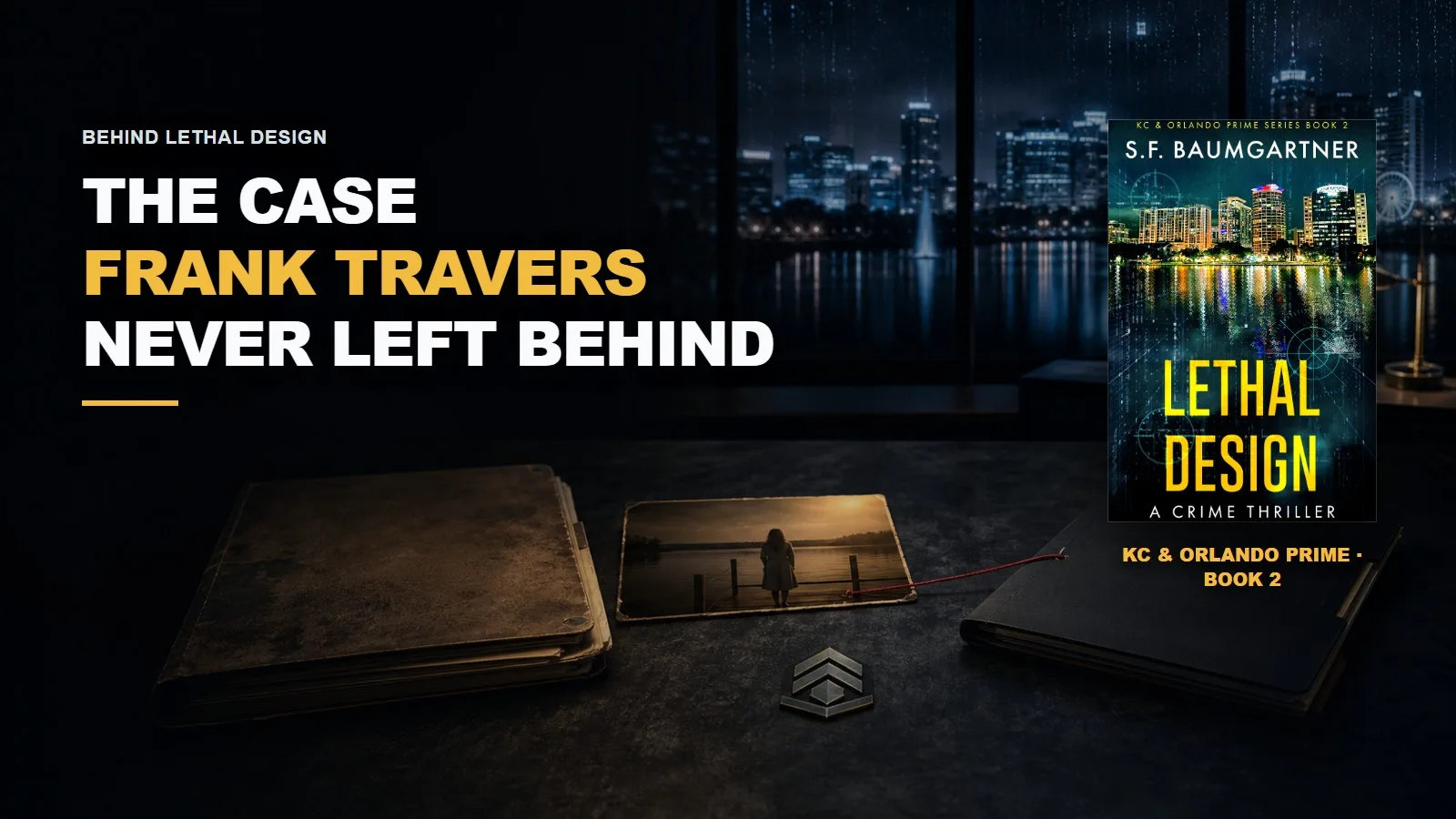
Some cases are closed.
Others simply stop moving.
Commander Frank Travers knows the difference.
In Lethal Design, Frank leads Orlando Prime through an investigation built from deaths that initially appear routine. The victims have no obvious connection. The scenes offer no clear reason to dig deeper. Only after separate clues begin converging does the team recognize that someone may be engineering the outcomes.
For Frank, however, the investigation is not entirely new.
It reaches toward the one case he has never been able to leave behind: his wife Linda’s murder.
The Man Who Keeps the Room Steady
Frank is accustomed to being the person who sees the larger picture.
As commander of Orlando Prime, he must coordinate investigators with different specialties, decide which leads deserve more resources, and keep several teams moving toward the same goal. When OPD Major Crimes and federal investigators enter the case, he also has to make sure information crosses agency lines without becoming distorted or lost.
That requires patience and control.
It becomes much harder when the evidence points toward his own past.
Frank cannot approach Linda’s case as a detached commander. He remembers the person behind the file, the life interrupted by her death, and the years in which every possible answer produced another dead end.
Yet he cannot afford to let grief decide what the evidence means.
When Personal History Becomes Evidence
A personal stake can make an investigator notice what others miss.
It can also make him see a connection he desperately wants to be true.
That tension matters more to me than the familiar image of a detective recklessly breaking every rule. Frank’s challenge is not whether he cares too much. He does. His challenge is whether he can trust the team around him enough to test his conclusions, challenge his assumptions, and follow facts that may lead somewhere he doesn’t want to go.
In other words, the same case that threatens his objectivity also forces him to rely on Orlando Prime more completely.
The investigation becomes a test of evidence, leadership, and trust.
The Person Behind the Cold Case
An unsolved murder can easily turn its victim into a plot point.
I didn’t want Linda to exist only as the reason Frank carries grief into Lethal Design. Before she became a cold-case file, she was his wife. She had her own work, humor, habits, and way of seeing through the man who never quite learned how to be off duty.
The spoiler-free bonus scene “Ten Years Ago” shows Frank and Linda at their Blackwater cabin before the central investigation begins. Nothing in it is required to follow Lethal Design, but it offers a quieter glimpse of what Frank lost and why one old photograph and one unresolved clue still matter.
Read the free Lethal Design bonus scene
Some investigators pursue a cold case because they cannot accept uncertainty.
Frank pursues this one because the past has begun moving again.
Lethal Design, Book 2 in the KC & Orlando Prime crime thriller series, is available now.
New to the team? Start with Fatal Invitation.
Could you trust your own judgment if the most important case of your career was also the most personal?