

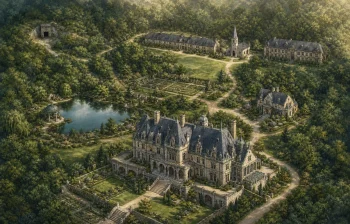
One of the questions readers occasionally ask is whether Mirror Estate is based on a real place.
The answer is both yes and no.
When I first imagined Mirror Estate, I knew I wanted something grand. A place with history. A place that could hold secrets. A place that felt large enough for generations of stories to unfold within its walls.
My biggest inspiration was the Biltmore Estate. I have always been fascinated by historic estates that seem almost like self-contained worlds. The architecture, the grounds, the hidden corners, and the sense that every room has a story all appealed to me as a writer.
But Mirror Estate didn’t come from a single source.
As I developed the series, I found myself borrowing ideas from castles and historic buildings across Europe. Some inspired the architecture. Others influenced the layout of the grounds, the tunnels, and the atmosphere that surrounds the estate.
One memory in particular played an important role.
Years ago, I visited a campus in Hong Kong that included a school, a chapel, and an orphanage operated by nuns. Everything existed together on the same property. The arrangement left a lasting impression on me. There was something special about having education, faith, and service intertwined in one place.
That memory eventually found its way into Mirror Estate.
The estate grew beyond the main house. A chapel appeared. An orphanage became part of the property. Later, plans emerged for that orphanage to become a school serving underprivileged children. Each addition helped the estate feel more alive and connected to the community around it.
Over seven books, Mirror Estate has become much more than a backdrop. It has witnessed celebrations, tragedies, investigations, reunions, and long-buried secrets.
In many ways, it has become a character of its own.
And like any good character, it still has a few secrets left to reveal.